
American Heritage Riverboat Accident
Reviewed by Michael S. Brandner Jr., Attorney, Mike Brandner Law. Last updated: November 17, 2026.
Were you on the American Heritage?
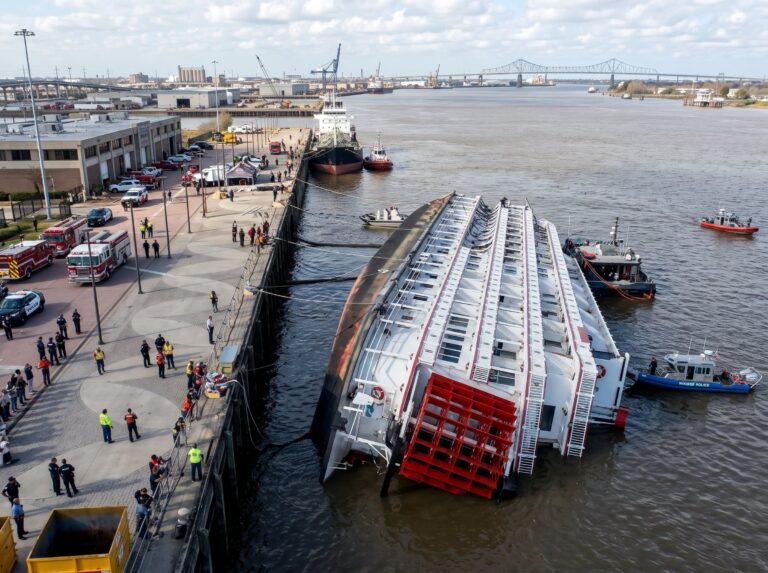
A tanker struck the American Heritage riverboat while it sat docked at the Port of New Orleans on Friday, November 13, 2026. Passengers were stepping off at the end of an eight-day cruise when the tanker lost its steering and collided with the riverboat. The riverboat rolled onto its side in the Mississippi River, and people went into the water. Thankfully, everyone aboard survived.
If you were aboard, or someone you love was, federal maritime law gives you rights. Some come with deadlines that arrive within weeks. This page explains what happened, who can file a claim, and what to do now.
For news coverage, see WWL-TV’s report on the riverboat sinking.

Tell us about your experience.
Start My Free Case Review
What We Know
American Heritage Riverboat Accident Key Facts
| When | On Friday, November 13, 2026, the tanker’s steering failed at 12:26 p.m., and it struck the American Heritage at 12:28 p.m., according to the NTSB’s preliminary findings. |
| Where | The Mississippi River at Mile 96, outside 1350 Port of New Orleans Place, near the Crescent City Connection. The American Heritage was docked at the Port’s Thalia Street Terminal, according to the Port’s lawsuit. |
| Riverboat | American Heritage, a paddlewheel riverboat operated by American Cruise Lines. Built in 2015 as the Queen of the Mississippi. Carries up to 150 passengers. |
| Tanker | Atlantic Asphalt (IMO 9798428), an asphalt and bitumen carrier that sails under the flag of the Marshall Islands. The tanker is being held in Gretna by Coast Guard order. |
| What happened | The American Heritage had been docked for about two hours so passengers could get off. The tanker’s rudder stuck to starboard, and it veered toward the east bank. It struck the riverboat’s port side. The American Heritage capsized within 22 minutes. |
| People aboard | Nearly 200 people, including passengers and crew. Everyone escaped alive. Passengers, crew members, and two police officers went into the river. |
| Injuries | Thirty-two passengers were taken to hospitals. As of Monday, November 16, four remained hospitalized, one seriously. |
| Investigation | The NTSB has reviewed the tanker’s voyage data recorder and is examining crew actions, the ship’s mechanical systems, and river conditions. The Coast Guard is also investigating. |
| Legal action | The Port of New Orleans sued Atlantic Asphalt, Nave Shipping, and Thome Ship Management in federal court, and a judge issued a warrant to arrest the tanker. The tanker’s owner is expected to ask a federal court to limit its liability. |
| Salvage | The American Heritage rests on its side, partly on the riverbed. About 16,000 gallons of diesel must be removed first, and salvage is expected to take more than a month. |
What We Don’t Know Yet
- Why the steering failed. The NTSB has identified a steering failure, but has not determined what caused it to fail.
- How many crew members were hurt. Official injury figures so far only cover passengers.
- When the tanker’s owner will file for limitation of liability.
- What deadline the court will set for claims.
- When investigators will release final findings.
Sources: Port of New Orleans statements as reported by WWL-TV; vessel details from The Waterways Journal and gCaptain; NTSB findings as reported by WDSU and WJLA; Mayor Helena Moreno’s remarks as reported by NBC News; hospital updates and the crew members’ lawsuit as reported by WDSU; the Port’s lawsuit, arrest warrant, and the tanker’s Gretna mooring as reported by WAFB; salvage details as reported by CNN; and the expected limitation filing as reported via Yahoo News.
Families Looking for Information
Everyone aboard the American Heritage survived. Thirty-two passengers were taken to hospitals, and as of Monday, November 16, four remained hospitalized, one seriously.
For official updates, follow NOLA Ready, the U.S. Coast Guard newsroom, and American Cruise Lines. Passengers taken off the vessel were brought to the Port of New Orleans Administration Building for help.
The needs of your family take priority. When you’re ready, save your paperwork and read the deadlines section below, because some deadlines arrive sooner than people expect.

GET A FREE CASE EVALUATION TODAY
Questions About the American Heritage Accident?
Call Mike Brandner Law at (504) 345-1111. The consultation is free, and we answer 24/7.
Timeline of the American Heritage Riverboat Collision
| Time | What happened |
|---|---|
| About two hours before the maritime collision | The American Heritage docks in New Orleans after arriving from Natchez, Mississippi, at the end of an eight-day cruise. Passengers begin getting off. |
| 12:26 p.m. | Passing near the Crescent City Connection, the Atlantic Asphalt suffers a steering failure. Its rudder sticks to starboard, and the tanker veers toward the east bank. |
| 12:28 p.m. | The Atlantic Asphalt strikes the American Heritage on its port side. |
| Within 22 minutes | The American Heritage rolls onto its side and takes on water. Passengers, crew members, and two police officers go into the river. Others hold onto the side of the boat. |
| Friday afternoon | The Coast Guard, harbor police, firefighters, EMS, and towboat crews pull people from the water. |
| Friday evening | All passengers are accounted for, and 32 are taken to hospitals. The Port of New Orleans sues in federal court, naming the Atlantic Asphalt, the company the lawsuit identifies as its registered owner, Nave Shipping SA, and its safety manager, Thome Ship Management. The suit alleges at least $1 million in damage to the Thalia Street Terminal. A judge issues a warrant for the tanker’s arrest. |
| Saturday | The Atlantic Asphalt is towed from the crash site and moored at the Perry Street Wharf in Gretna. Four American Heritage crew members sue the tanker’s owner and operator. |
| Sunday | The Coast Guard begins salvage surveys of the American Heritage. |
Who Can File a Claim after the American Heritage Riverboat Accident?
Passengers, crew members, and workers hurt during the rescue can all have claims after the American Heritage accident. The law that applies depends on why you were on or near the boat.
Passengers on the American Heritage
Passengers hurt in the collision, the capsizing, or the evacuation can bring claims under general maritime law against the parties whose negligence caused their injuries. Accidents like this one cause broken bones, head and brain injuries, crush injuries from a tilting deck, near-drowning, hypothermia from cold-water immersion, and lasting anxiety or PTSD.
You do not need a visible injury to have a claim. See the FAQ below on emotional injuries and lost belongings.
American Cruise Lines Crew Members
Crew members who qualify as seamen have rights passengers do not. The Jones Act lets a seaman sue the employer when negligence played any part in an injury. Seamen can also bring an unseaworthiness claim against the vessel owner. They are owed maintenance and cure as well: daily living expenses and medical care paid until they reach maximum medical improvement, regardless of fault. Learn more about Jones Act claims.
Dock Workers, Port Employees, and Rescuers
The law that covers a worker hurt on the dock or in the water depends on who they work for and what they do.
- Dock and terminal workers: Many workers who load, unload, or service vessels on the riverfront are covered by the federal Longshore and Harbor Workers’ Compensation Act. It pays medical care and lost wages regardless of fault.
- Police, firefighters, EMS, and other public employees: Two police officers went into the river when the tanker hit. The Longshore Act excludes government employees, so their benefits usually come from state or federal programs instead.
- Crews of towboats and other vessels that helped in the rescue: Vessel crew members are generally covered by the Jones Act, not the Longshore Act.
Whatever benefits apply, a worker hurt because of the tanker’s negligence can often bring a separate claim against its owner.
Atlantic Asphalt Crew Members
Crew aboard the Atlantic Asphalt also have maritime rights. Because the tanker sails under a foreign flag, their claims can raise questions about which country’s law applies.
Who Is Responsible for the American Heritage Collision?
When a moving ship hits a docked or anchored vessel, maritime law presumes the moving ship is at fault. Courts call this the Oregon Rule, after an 1895 U.S. Supreme Court decision. The American Heritage was docked. The Atlantic Asphalt was moving, and the NTSB’s preliminary findings point to a steering failure on the tanker.
A crash between a moving vessel and a stationary one is called an allision. In federal courts in Louisiana, the presumption puts the burden of proof on the moving ship.
To overcome it, the tanker’s owner must prove the tanker used reasonable care, that the riverboat was at fault, or that the crash was an accident no one could have prevented. Courts treat that last defense as hard to prove. The rule does not settle the case, but it puts the tanker on the defensive from the start.
The NTSB says it is reviewing crew actions, the ship’s mechanical systems, and river conditions. Questions will likely include:
- The Atlantic Asphalt’s owner and operator: maintenance, engine and steering performance, crew training, and navigation.
- The tanker’s master and any river pilot aboard: speed, course, and decisions in the minutes before impact.
- American Cruise Lines: where and how the riverboat was moored, crowd control on deck, and how the evacuation was run.
Key evidence includes voyage data recorders, radio traffic, vessel tracking data, maintenance logs, video, and crew statements. The companies involved control most of it. A Louisiana maritime injury attorney can send preservation demands so that evidence is not lost.

Is My Cruise Ticket a Contract?
Yes. American Cruise Lines’ terms and conditions of passage form a binding contract, and courts generally enforce them. For injury claims, ACL’s published terms require written notice with full details at its principal office within six months, a lawsuit within two years, and service on ACL within 120 days of filing. Property claims are shorter: notice within 30 days and suit within six months. The terms also require suing ACL in federal court in Connecticut.
Federal minimum deadlines apply to ocean-going passenger ships. The American Heritage is a river vessel, so those minimums likely do not apply here. A separate federal law voids ticket terms that try to excuse a carrier from liability for injury or death caused by its negligence. These deadlines apply to claims against the cruise line, not the tanker’s owner. Find your ticket contract and booking emails now. The version that binds you is the one in effect when you first paid.
American Heritage Riverboat Accident Deadline
After a major accident, a vessel owner can ask a federal court to cap its total liability at the value of the vessel after the accident. For a boat that capsized, that value can be small. The court then halts other lawsuits and sets one deadline for every claimant, announced by newspaper notice most people never see. Miss it, and you can lose your claim. The cap is not automatic. The owner must prove it had no knowledge of or part in what caused the accident.
Maritime Law Statute of Limitations
Most maritime accident injury claims, including Jones Act claims, must be filed within three years under federal law. Treat three years as the outer limit. The ticket and court deadlines come first.
What to Do after the American Heritage Riverboat Accident
- See a doctor. Head injuries, complications from inhaling river water, and the effects of cold-water exposure can show up hours or days later.
- Keep your paperwork. Save the ticket contract, booking and payment confirmations, boarding documents, and any messages from American Cruise Lines.
- Share photos and video with investigators. The NTSB has asked anyone with photos or video of the crash to submit them. Back up your own copies first.
- Document facts: Write down where you were standing, what you saw and heard, and who was near you.
- Track your losses, including medical bills, missed work, lost belongings, and the cost of getting home.
- Read before you sign. The cruise line or an insurer may offer a refund, a travel credit, or a quick payment. Some offers include a release that gives up your right to a claim. Have a lawyer review it first.
- Keep the accident off social media. Posts about what happened can be used against you when you file a claim for damages.
- Call a New Orleans maritime injury lawyer before the deadlines above run.
FREQUENTLY ASKED QUESTIONS
American Heritage Riverboat Accident Claim FAQs
Riverboat passengers injured in the American Heritage accident can bring maritime injury claims against any party whose negligence caused their injuries. That can include American Cruise Lines, the owner and operator of the Atlantic Asphalt tanker, or both. Your ticket contract may set short notice and filing deadlines, so find it and review it early.
I live outside Louisiana. Can I work with a New Orleans lawyer on an American Heritage claim?Yes. You do not need to live in Louisiana to hire a Louisiana maritime injury lawyer for an accident that happened here. The American Heritage accident happened in New Orleans, and the investigation and much of the evidence are here. Where a case is filed depends on the ticket contract and where each company can be sued.
Possibly. Federal maritime law can allow recovery for emotional injuries such as anxiety or PTSD. Many courts allow it when a person is placed in immediate danger of physical harm. Courts in Louisiana have generally looked for some physical contact. Passengers who went into the river or fell as the American Heritage rolled may have stronger claims. A lawyer can review your situation.
Possibly. American Cruise Lines’ published terms cap its liability for lost belongings at $100 per passenger and exclude cash, jewelry, and electronics such as phones. That cap does not bind the tanker’s owner, who may owe full value if the tanker was at fault. The terms also require written notice of a property claim within 30 days. Save receipts or photos of what you brought aboard.
Yes. A foreign flag does not protect a ship’s owner from claims over an accident in U.S. waters. Maritime law gives injury victims a lien against the ship that caused the harm. The Port of New Orleans has already had the Atlantic Asphalt arrested to secure its own claim. Injured people need to protect their own claims, and if the owner files a limitation case, every claim will move into that one court. Acting early matters.
Generally, no. Federal law keeps the Coast Guard’s marine casualty report out of civil lawsuits, including its findings of fact and conclusions, and parties can’t obtain it through discovery. The underlying evidence is different. Vessel data, records, video, and witnesses can still be pursued directly. That’s why preserving evidence early matters after the American Heritage collision.
Read any offer before you sign it. After accidents, refunds, travel credits, and quick payments sometimes come with release language that gives up your right to an injury claim. If American Cruise Lines or an insurer sends you paperwork after the American Heritage accident, have a lawyer read it first.
In most cases, yes. If you worked aboard the American Heritage, you likely qualify as a seaman. That means the Jones Act lets you sue American Cruise Lines if its negligence played any part in your injury, even a small one. ACL also owes you maintenance and cure, which covers your living expenses and medical care while you recover, no matter who was at fault. You may have a claim against the tanker’s owner, too. Four of your fellow crew members have already filed one.
SERVING THE STATE OF LOUISIANA
Contact an American Heritage Riverboat Accident Lawyer
American Cruise Lines and the tanker’s owner will have lawyers and insurers protecting their interests. You should have someone protecting yours.
Mike Brandner has practiced law in Louisiana since 2002, and he has won jury verdicts for clients with serious injuries. His work has earned recognition from Louisiana Super Lawyers (2015, 2016, and 2020 through 2026), The National Trial Lawyers Top 100 (2018 and 2019), and The Million Dollar Advocates Forum.
If you were on the American Heritage or were hurt during the response, Mike Brandner will go over what happened and explain your options in plain language. Don’t wait. American Cruise Lines’ terms set a 30-day notice deadline for some claims, and the tanker’s owner is expected to ask a court to set a single claims deadline.
The consultation is free. Call (504) 345-1111 now, use LiveChat, or use a secure online form to learn more about your legal rights. Mike Brandner Law is on call 24/7.
Mike Brandner represents people hurt in maritime and personal injury accidents across Louisiana, from the New Orleans riverfront to Algiers and Gretna on the West Bank. Clients can meet with us at our Metairie office.
Past results are not a guarantee of future success.