
Offshore Medic Misdiagnosis: Who Pays for the Mistake?
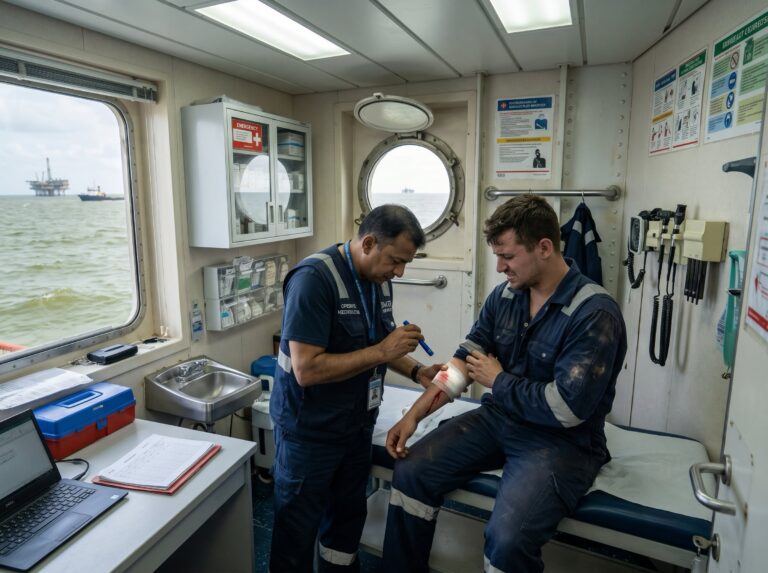
On land, you can always get a second opinion. Offshore, you see whoever the company put aboard, whether that’s a paramedic, a nurse, or a crewmember with a first aid card and a medicine chest. When that person gets it wrong, you’re the one who lives with the result. An offshore medic misdiagnosis can turn a fracture into a “bruise” and a torn tendon into a “sprain,” and the injury gets worse with every shift you work.
Thankfully, the law doesn’t expect you to absorb that mistake on your own. If you’re a seaman, your employer can be held responsible for the medic’s error and for the added harm it caused. The experienced maritime injury lawyers at Mike Brandner Law help injured workers hold companies accountable when the medical care aboard falls short.

Free Case Evaluation
Complete the form below and a member of our legal team will contact you to discuss your case.
Employer Liability for Rig Medic Negligence
You didn’t pick the medic. The company did. Under the Jones Act, a seaman’s employer has a duty to provide prompt and adequate medical care, and that duty doesn’t disappear when the company hands the job to someone else. As a result, rig medic negligence is generally treated as the employer’s negligence.
If the medic is a company employee, your employer is responsible for his or her mistakes. Even when the medic works for an outside contractor, courts often still hold the employer liable. The same goes for ship’s doctor malpractice covered by Jones Act protections, such as a misread X-ray or chest pain written off as heat exhaustion. Note that this works differently from an ordinary medical malpractice claim on land, since your case usually runs against your employer.
This holds true whether you work a rig supplied out of Port Fourchon or a liftboat based near Houma. In some situations, the medic’s lack of training can also create a second claim against the vessel owner.
When an Unfit Medic Makes the Vessel Unseaworthy
Vessel owners must provide a seaworthy ship, and that includes a competent crew. One honest mistake by a capable medic usually won’t make a vessel unseaworthy. However, a medic who never had the proper training or credentials can. The same is true of a medical locker missing basic supplies, like splints or a working defibrillator.
Unlike a Jones Act claim, unseaworthiness doesn’t require proof that the company knew about the problem. Instead, you need to show the problem existed and played a substantial part in your injury. A Louisiana maritime accident attorney can look into the medic’s background and the vessel’s medical supplies to see whether this claim fits your situation.
Proving an Offshore Medic Misdiagnosis Claim
In a typical injury case, you have to prove the other side’s negligence caused your harm. The Jones Act sets a much lower bar. Under this law, you only need to show that your employer’s negligence played a part, even a small one. For that reason, proving an offshore medic misdiagnosis usually comes down to comparing what the medic wrote down with what a doctor found later.
Our attorneys will request the vessel’s medical log along with every note the medic made about you. If those records show the medic brushed off clear warning signs, or never called a doctor ashore for advice, your claim gets much stronger. From there, the focus shifts to how much damage the wait caused.
Related: What to Do after an Offshore Injury

How a Missed Diagnosis Makes an Injury Worse
Some injuries hide well. Swelling covers a fracture, and a herniated disc can feel a lot like a pulled muscle. When a medic misses one of these and clears you for duty, every shift adds to the harm. For example, a broken ankle that needed a cast in the first week may need plates and screws a month later. Torn tendons are another common example, and an Achilles tendon misdiagnosis can end an offshore career.
In the worst cases, a misdiagnosed injury offshore keeps you away from a hospital until the damage is permanent. Unfortunately, by the time a real doctor sees you, the window for a simple fix may already be closed.
Aggravation of Injury Maritime Claims
The law has a name for this extra harm. It’s called aggravation. In aggravation of injury maritime claims, your employer is responsible not only for the accident but also for everything the bad call added on top of it. Think of the bigger surgery, the longer recovery, and the permanent limp that early care may have prevented.
This is true even if nobody caused the original injury. For instance, a deckhand who twists an ankle on a dry, clear deck may have no negligence claim for the fall itself. However, if the medic sent him back to work on a fractured foot, the company can answer for every shift that made it worse. The same idea applies when a company drags its feet on a delayed medevac. Here’s what that responsibility can mean for you.
Compensation for an Offshore Medic Misdiagnosis
Depending on your situation, you may be entitled to compensation for:
- Corrective medical care: The second opinion, the MRI, and the surgery that should have happened weeks earlier.
- Pain and suffering: The days you spent working through pain because a medic said you were fine.
- Lost wages and earning capacity: The pay you miss while you heal, plus offshore income you can no longer earn.
- Maintenance and cure: Daily living costs and medical bills, which your employer owes even if the misdiagnosis was an honest mistake. Learn more about maintenance and cure.
Keep in mind that every offshore medic misdiagnosis case is different. Ultimately, the value of your claim depends on how serious the injury was and how much harm the delay added.
FREQUENTLY ASKED QUESTIONS
Offshore Medic Misdiagnosis FAQ
Seamen who learn the medic got it wrong usually have the same handful of concerns. Mike Brandner Law has answered several of them here.
See a doctor you choose as soon as you’re back on land, and tell that doctor exactly what happened aboard. Next, ask the company for copies of the vessel’s medical log and your treatment notes. Writing down what you told the medic, and how many shifts you worked afterward, will help too.
That’s completely normal, and it won’t ruin your case. Seamen are expected to rely on the medical care their employer provides. In fact, the shifts you worked on a medic’s say-so can help prove how much worse your injury became. A Louisiana maritime accident attorney will use that timeline to show the full price of the company’s mistake.
Like most maritime injury claims, an offshore medic misdiagnosis claim generally must be filed within three years. Even so, acting early makes a real difference. Medical logs get misplaced, and crewmembers move on to other vessels.
In most cases, your employer pays. Because the company chose the medic and controls the care aboard, it usually answers for the mistake under the Jones Act. That applies whether you crew a supply vessel out of New Iberia or anywhere else along the coast. If a different company owns the vessel, it may also share responsibility through an unseaworthiness claim.
As long as you qualify as a seaman, yes. The Jones Act allows you to file a lawsuit against your employer if negligence or recklessness played a part in your injury, and that includes the harm from an offshore medic misdiagnosis.
SERVING THE STATE OF LOUISIANA
Legal Help for an Offshore Medic Misdiagnosis
When the person responsible for your care offshore gets it wrong, you shouldn’t be the one who pays for it. Mike Brandner Law can protect you and fight for your best interests. Let us take care of all your legal needs so that you can focus on your health.
Our experienced Jones Act lawyers will compare the medic’s notes with what your doctor found ashore to build a strong offshore medic misdiagnosis claim. You can reach a Louisiana maritime accident attorney from our firm by phone any time, day or night, and your first consultation is free. If you’d rather start online, send your consultation request through our encrypted contact form or speak with our LiveChat team.